
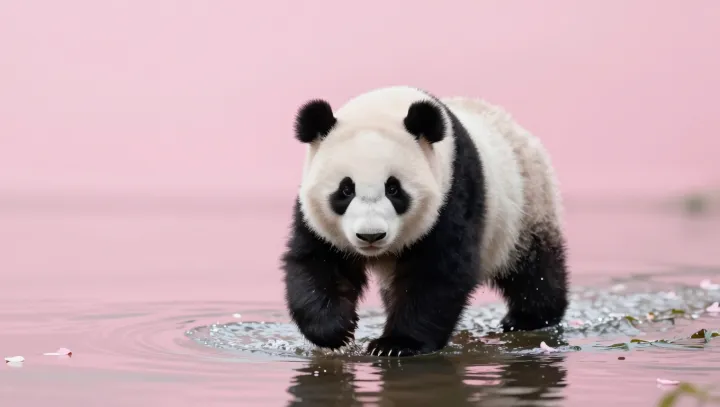
That stuffed‑toy look is a deception. The black‑and‑white coat of a panda cub acts less like decoration and more like a living parka, built from thousands of hair shafts per square centimeter that trap air and slow heat transfer through conduction and convection. Each guard hair overlays a layer of fine underfur, creating a multi‑layer barrier that cuts energy loss in still air and in wind‑chilled, snowy undergrowth.
More striking is how this coat doubles as visual armor. Biologists argue that the white zones scatter light against snow and fog, while the black limbs and eye patches disrupt the animal’s outline, a form of disruptive coloration backed by optical contrast measurements. Melanin in the dark fur also absorbs solar radiation, converting short bursts of weak sunlight into a marginal but real gain in body temperature, supporting basal metabolic rate in a habitat where food energy is limited.
Counterintuitive, too, is how early this system comes online. Even though newborn cubs appear fragile, their fur quickly shifts from sparse to hyper‑dense, with hair shaft microstructure that reduces thermal conductivity and maintains a narrow skin temperature range. What looks to humans like plush softness is, in biological terms, a precision‑tuned insulation matrix that lets an animal with limited fat reserves stay alive in cold forests that do not care how cute it seems.