
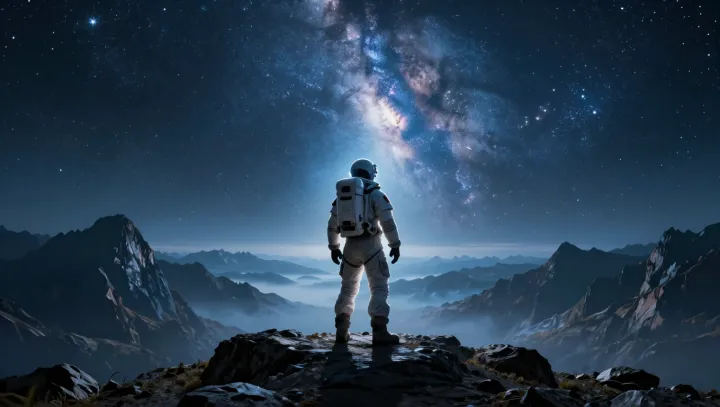
The scandal here is that “up” on that mountain is already a negotiated truce, not a pure direction. Above the summit, Earth’s gravitational field lines point roughly toward its centre, so the astronaut’s inner ear and the plumb line agree: down is into the rock, up is away from it. Yet the sky that astronaut stares into is shaped by the Milky Way’s mass distribution, which curves spacetime on a scale the vestibular system cannot sample at all.
More radical still, general relativity says there is no universal up, only geodesics in curved spacetime. Locally, the astronaut’s proper acceleration through Earth’s field sets the reference frame, but the galactic gravitational potential and even the dark matter halo add tiny vector components that tilt the true free‑fall path. Short sentence. Perception edits this away, enforcing a clean vertical tied to the mountain while gravitational lensing and orbital dynamics quietly testify that every chosen down is provincial.
The unsettling implication is that the astronaut’s sense of orientation would fragment once instruments enter the story. A spirit level, a star tracker, and a map of the galactic plane would each nominate a slightly different vertical, revealing that cognitive up is a human‑scale fiction draped over a many‑body solution to Einstein’s field equations.