
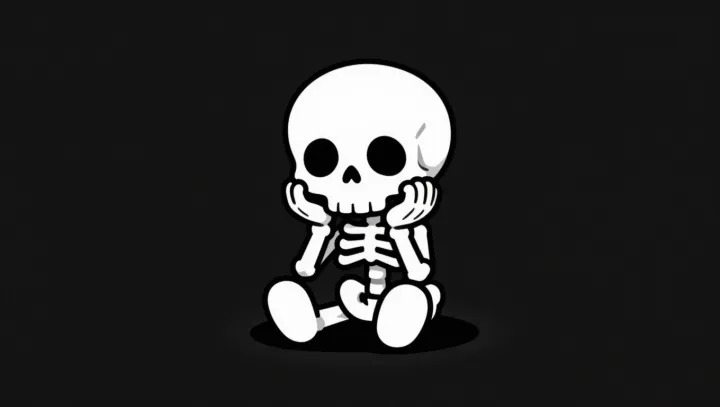
A naked cartoon skull should feel dead. Instead, a simple grin and two hollow eye sockets can register as oddly vivid, even friendly. That reaction is not about ink on paper; it is about a visual system trained to treat almost any face-like signal as socially urgent.
What looks like whimsy is really a harsh efficiency hack. Face-selective regions such as the fusiform face area and superior temporal sulcus fire for crude patterns that mimic eyes and a mouth, a bias linked to pareidolia and hyperactive agency detection. Give those circuits a curve for a smile and asymmetry for cheeks, and the brain supplies missing anatomy, motion, even attitude. Story sense piles on. Once a skull appears to smile, mirror neuron networks and theory-of-mind processes infer intent, mood and backstory from that fixed line, compressing a character arc into a few strokes. The skeleton does not move; internal predictive processing does, filling in muscle, voice and context.
The unsettling truth is that such a drawing feels alive precisely because it is starved of detail. Sparse cues force perception and narrative machinery to work harder, and that cognitive labor is what animators, meme makers and advertisers quietly leverage when they strip a figure to bones and a grin.