
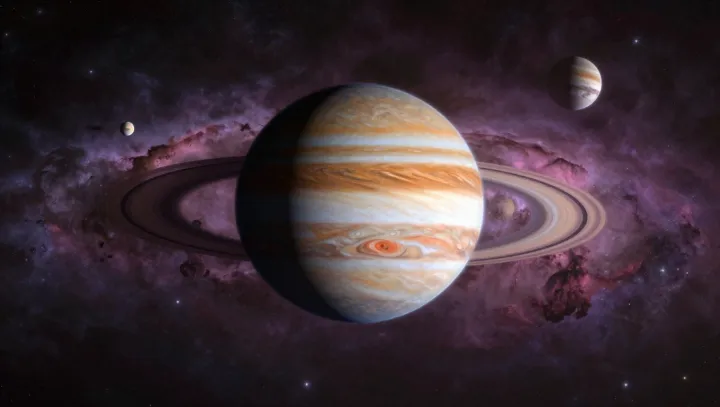
A night under a ringed gas giant would feel more like standing beneath a dim city canopy than inside a cosmic void. That brightness starts with simple geometry: the planet’s disk spans dozens of times the area of Earth’s Moon, and its icy rings add an enormous reflective halo, so any ambient glow in the nebula has far more surface to hit and bounce toward the ground.
More striking is how restless that light becomes. A dense purple nebula is not empty; it is packed with dust grains and gas that scatter photons through Rayleigh scattering and Mie scattering, tinting and diffusing starlight into a permanent low-level radiance. The rings intercept that diffuse glow, turning them into a giant, tilted projection screen whose brightness shifts as the planet rotates and as small clumps and gaps in the ring material slide across one another, like moving blinds.
Even shadows refuse to stay simple. The planet casts a broad umbra, but the translucent rings throw layered penumbrae, so a walker would see bands of brighter and darker ground sweeping past as orbital motion slowly realigns ring planes with nebular hot spots. Compared with the steady, single-source illumination of a full Moon, such a sky would be louder in light, its variability written directly by orbital mechanics.