
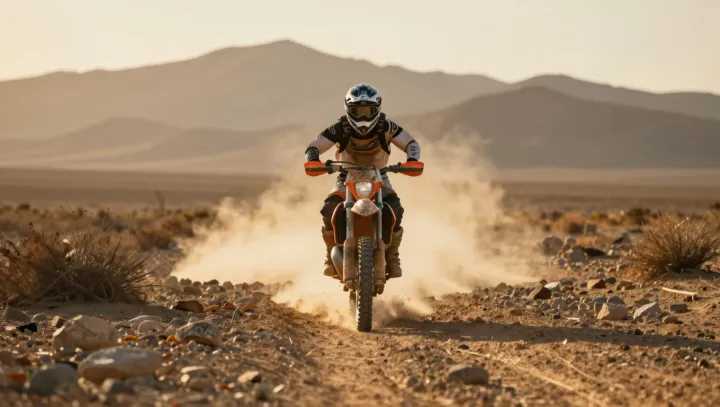
Stone and sand, not the rider, decide who gets through a rock garden. On loose rock, the fastest line starts with a softer right hand, not a harder hit of power. Where beginners snap the throttle, experts roll it on like a dimmer switch, feeding just enough torque to keep the tire biting.
Violent throttle is a bad bet. It spikes rear-wheel torque, overcomes static friction, and instantly turns grip into wheelspin. Once the tire breaks loose, the contact patch skims over the rocks, suspension packs, and the chassis starts to yaw. With a smooth, progressive input, torque stays below the slip threshold longer, the rubber deforms around edges, and the knobbies key into the surface instead of skating across it.
The calm hand also manages weight transfer. A sudden burst pitches mass rearward, extends the fork, and lightens the front, so steering precision vanishes just when sharp rocks demand accuracy. A steadier drive keeps the suspension working within its damping range, lets the tire follow micro-terrains, and converts engine output into forward momentum instead of spray and noise. On brutal rock gardens, restraint becomes the real accelerator.