
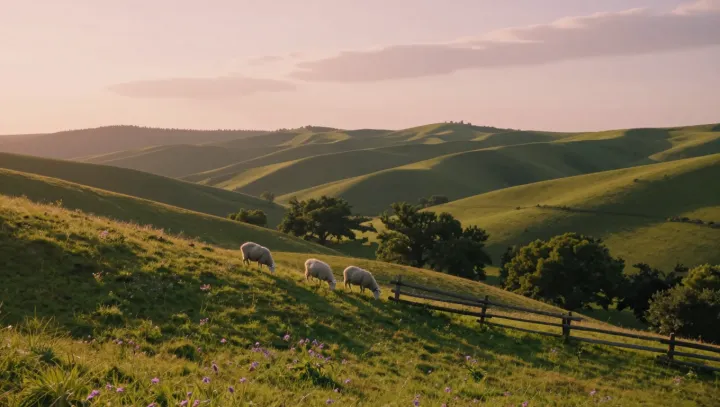
A slow, almost static hillside is not gentle; it is neurologically efficient. Sparse motion, a fixed horizon, and a few grazing sheep present the visual cortex with a low-entropy scene, so edge detection and motion tracking circuits barely work compared with their workload during rapid editing. With less sensory input to encode, the thalamus passes on a quieter stream, and the amygdala receives fewer abrupt onsets that it might misclassify as potential threats.
Fast-cut “relaxing” videos pretend to soothe while they keep the alert system on a short leash. Each jump in framing, each sudden zoom, is a micro “novelty” event that spikes orienting responses and keeps the locus coeruleus and sympathetic nervous system primed. By contrast, a hillside changes so slowly that prediction error in the visual cortex stays low; nothing violates expectation, so autonomic arousal drifts down and heart rate variability can normalize without competition from constant visual alarms.
The deeper claim is blunt: calm requires boredom at the level of photons. When the scene offers almost nothing new, higher-order attention networks stop scanning for what might appear next and slip into default mode network activity, associated with mind-wandering and emotional integration. A few sheep cropping the same patch of grass are not just pastoral decoration; they are a controlled reduction of data throughput that lets the threat circuits stand down.