
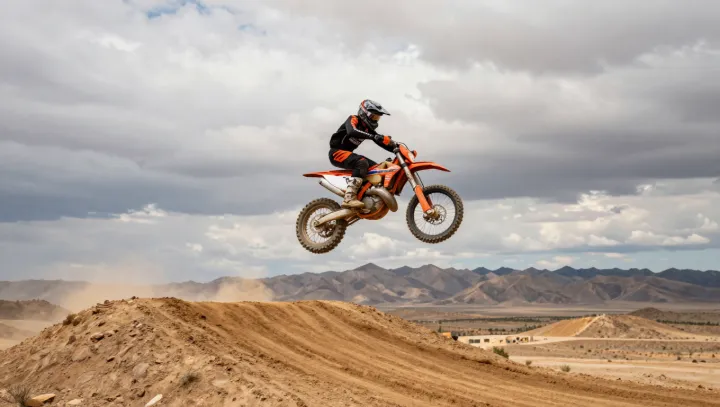
The real speed gain off a jump comes from the hips, not the throttle. In midair, pros use a tiny lateral hip shift to reorient the bike, turning a sketchy nose-high or rear-high arc into a low, fast glide that touches down ready to accelerate.
What looks like style is actually applied physics. By shifting the hips slightly off centerline, the rider changes the combined center of mass of body and machine, which alters angular momentum around the roll and pitch axes without any need for extra engine input. The front end can be coaxed down, or the rear can be floated up, by loading one side of the pegs while the upper body counters, a move that acts like a micro aileron in an aircraft, governed by rigid body dynamics.
Smooth landings are not about bravery; they are about shortening airtime. A flatter arc means the suspension compresses in line with the direction of travel instead of fighting a steep impact vector, which reduces energy loss and lets the tires regain mechanical grip sooner. That cleaner transfer of kinetic energy into forward drive, rather than vertical bounce, lets elite riders exit the landing ramp already poised for the next braking zone or rhythm section.
More throttle in the air is a blunt tool; the hip shift is a scalpel. Throttle-only corrections rely on rear wheel inertia and can overshoot, wasting distance and time, while the lateral hip move is instant, reversible, and costs no fuel. In that invisible midair twitch lies the difference between hanging on and deciding where the next section really begins.