
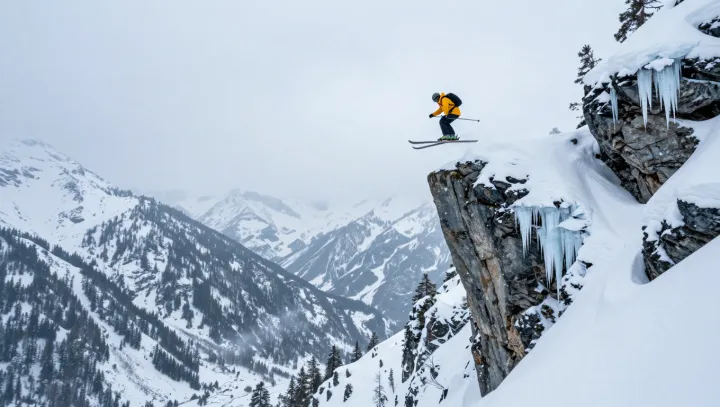
Edge grip, not gear volume, decides who stays upright on a scary-steep line. The real performance upgrade hides in how boot last, cuff angle and binding delta align with a skier’s actual joint range and neuromuscular control, so that every degree of ankle flexion transfers cleanly into edge angle instead of vanishing as wobble and compensation.
Comfort-first thinking is wrong here. A boot that feels plush but allows talus and tibia to slide inside the shell forces reflexive co-contractions, burns through glycogen, and slows reaction time just when the fall line punishes hesitation. Match shell volume, liner density and forward lean to the skier’s dorsiflexion and hip mobility, and suddenly the same person can hold a micro-adjusted platform on boilerplate without changing skis at all.
Marketing loves lighter planks, yet binding geometry quietly runs the show. Ramp angle, stack height and mounting point shift the skier’s center of mass a few centimeters; on steep snow that shift changes pressure distribution across the ski’s running length, altering how quickly the sidecut engages and releases. When that geometry is tuned to the skier’s stance width and habitual femur rotation, jump turns land quietly, edges set faster, and speed stays inside a controllable envelope.
Hero snow flatters bad matches; true steep lines expose them. Pick terrain that sits just inside the skier’s dynamic balance envelope, where vestibular and proprioceptive systems can still build a stable internal model of the slope, and every turn becomes high-yield feedback on the boot-binding-body system. The loud jacket stays just that: loud. The invisible alignment work, though, is what keeps the skid from becoming a slide.