
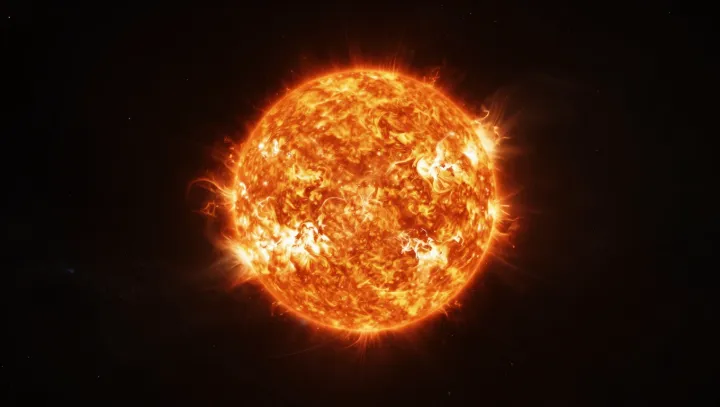
Violence is the normal state of a star, not a sign it is about to explode into pieces. Around it, the corona launches million‑degree plasma, yet the core’s gravity writes the only rule that matters for stability.
That dominance starts with mass. A star packs so much material into a compact sphere that its gravitational acceleration at the surface dwarfs the outward shove of radiation pressure, even though photons stream out in staggering numbers. Only when luminosity approaches the Eddington limit does light pressure seriously compete with gravity, and most ordinary stars sit safely below that theoretical ceiling, so their own glare cannot unbind them.
The hot corona looks like an escape in progress, but it is mostly a sideshow. Plasma there is trapped and guided by magnetic field lines through a process described by magnetohydrodynamics, with flares and coronal mass ejections acting more like leaks in a boiler than a full structural failure. Mass loss through stellar wind is tiny compared with the star’s total mass, so the hydrostatic equilibrium between inward gravity and outward gas pressure in the interior barely notices the chaos above. Light pushes. Gravity grips harder.