
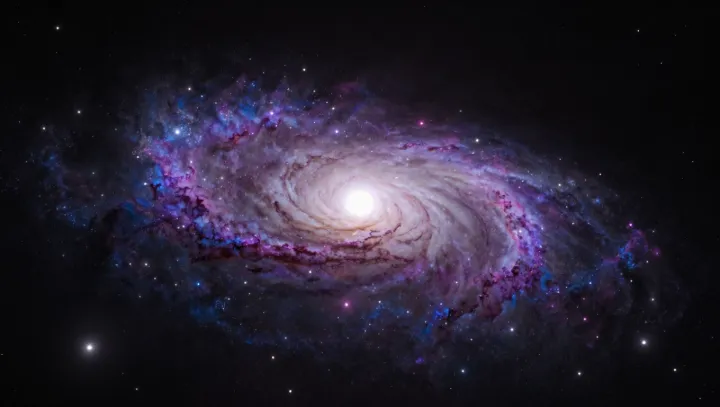
The calm is a lie. Those neat spiral arms, blue knots of new stars, and dark dust lanes sit inside a gravitational brawl so slow the human eye edits it out. A spiral galaxy is not a picture; it is a process, locked in a feedback loop of starbirth, orbital shear, and constant tug-of-war with its environment.
The harsher truth is that many spirals are already being pulled apart. Tidal forces from nearby galaxies stretch their stellar disks, drawing out tidal tails and warps that trace the underlying gravitational potential. Within each system, differential rotation and density waves rearrange gas along spiral arms, while dynamical friction drags satellite galaxies inward, stirring the disk and thickening it over time.
The most deceptive cases are the quiet ones. A galaxy can look intact while its outer gas is stripped by ram pressure as it plunges through a cluster, quenching star formation from the edges inward. Dark matter halos, invisible but massive, set the rotation curve and control how resilient those disks are to harassment, deciding whether a spiral keeps its pinwheel outline or fades into a smooth, anonymous smear of stars.