
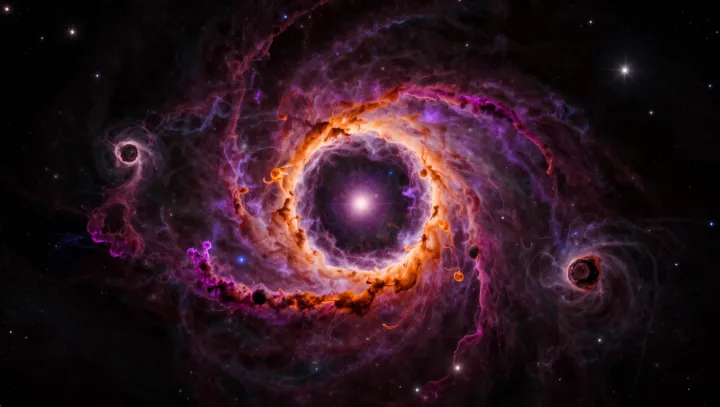
A so‑called cosmic eye is not gentle at all; it is forensic evidence. The bright ring astronomers call a planetary nebula is the exposed aftermath of a star that shed its outer layers, leaving a dense white dwarf at the center while a thin shell of ionized gas races outward.
That apparent contradiction, grave and nursery in one frame, is built into stellar physics. The white dwarf, supported by electron degeneracy pressure, is effectively a stellar remnant; nuclear fusion has shut down in its core, and only residual thermal radiation keeps it shining as it cools. Around it, the expanding envelope, rich in carbon, nitrogen and oxygen forged by nucleosynthesis, plows into the surrounding interstellar medium and mixes with colder molecular clouds.
So the eye watches nothing; it supplies ingredients. As the gas disperses, it increases the local metallicity of the galactic gas reservoir, altering cooling rates inside future collapsing clouds through atomic line emission and dust formation. Regions that accumulate enough of this recycled material can undergo gravitational collapse, ignite hydrogen fusion in new protostars, and eventually light up as fresh suns that carry the chemical fingerprints of the original corpse.