
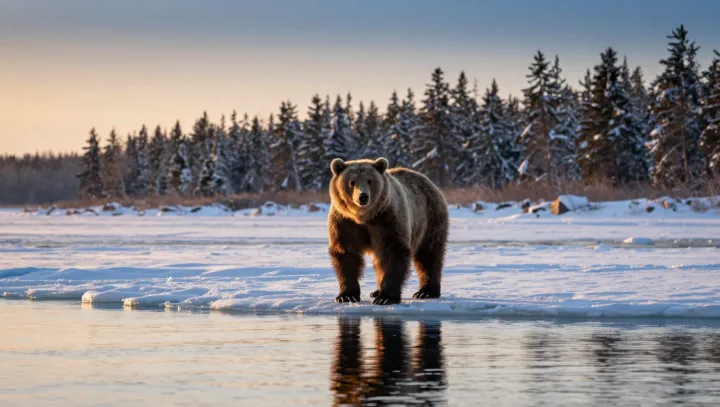
River ice looks hostile, yet for a brown bear it functions almost like a bench. Flat, bright, thin as glass in places, the frozen surface still steals heat through conduction and wind. A human body, with relatively bare skin and modest fat, would lose core temperature fast and drift into hypothermia.
The bear’s real trick is not strength but insulation. Dense guard hairs trap still air; a thick underfur layer further slows conduction; subcutaneous fat acts as a low-conductivity barrier that keeps core tissues buffered while skin temperature can safely fall. Human skin, with patchy hair and far less adipose tissue, cannot create that multilayer thermal shield, so heat flows out far more quickly.
Even that is only half the story. Large body mass reduces surface-area-to-volume ratio, so a three-hundred-kilogram bear simply leaks less heat per unit tissue than a person. Inside, peripheral vasoconstriction and countercurrent heat exchange in limbs limit warm blood reaching the ice-contact zones, while brown adipose tissue and controlled metabolic rate maintain deep-organ temperature without exhausting energy reserves. A human on that same ice lacks comparable vascular design and insulation, so survival time contracts to minutes, not hours.