
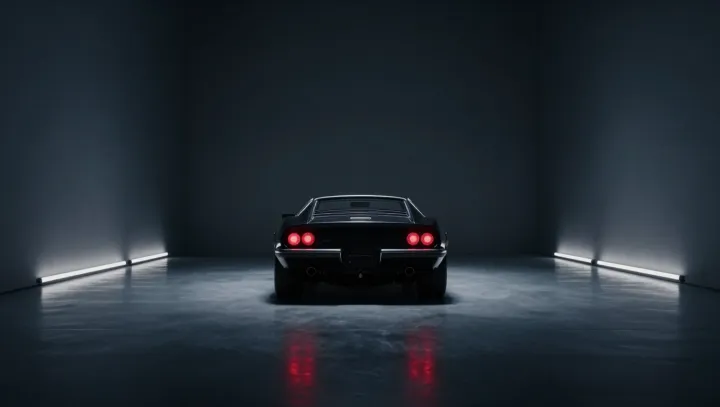
That rear is a ghost. Flat strakes, full-width lamps, a blunt red wall of intent; the Ferrari 512 TR fixed an outline in the collective brain that modern supercars rarely copy yet never quite escape. The car arrived at a hinge point between analog theatre and the wind tunnel’s quiet tyranny, and its tail sits exactly on that fault line.
The first claim is uncomfortable for designers: the 512 TR’s rear is famous not because it is pure, but because it is legible. One glance and the massing reads like a diagram of speed; wide track, low deck, horizontal graphics stretching the car to the edges. Human visual cortex loves such strong Gestalt cues, so advertising art directors and videogame modelers seized it, repeating that graphic block until it became visual shorthand for excess, even as actual drag coefficients and cooling demands pushed real cars toward sculpted vents and broken light signatures.
The deeper irony is that engineering killed the very look engineering once enabled. Package constraints for mid-mounted powertrains, crash structures, diffuser volumes and rear aero load now favor cutouts, flying buttresses and complex LED clusters. Yet the 512 TR’s rear persists as mental clip art because it compresses function into a single, bold plane: intake, exhaust, lighting and brand identity resolved into stacked horizontal bars. When people sketch a supercar from memory, they do not draw what exists on the road; they draw that remembered diagram of purpose, and that diagram still wears Ferrari’s strakes and a glowing red band.