
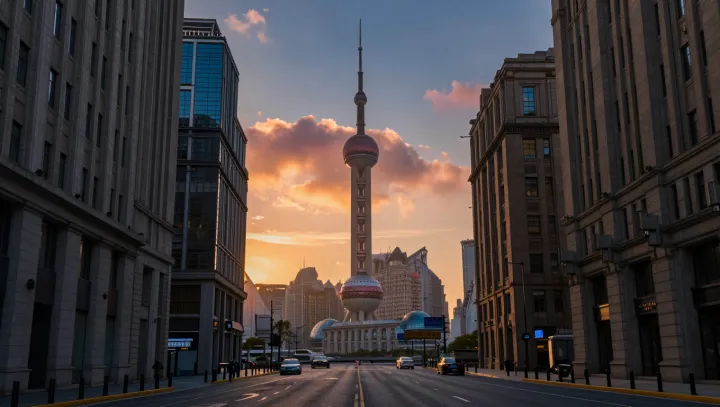
Golden light cheats the guidebook. Between glass towers and narrow streets, sunsets hit harder than at any landmark. Here, geometry and optics do the quiet work, turning anonymous blocks into accidental observatories for the day’s last light.
The odd truth is that a cramped street can stage a sunset better than an open plaza. Long, straight corridors between high‑rise façades act as urban canyons, extending the apparent path of the sun across the horizon. Linear perspective squeezes distance, so the solar disk looks larger and more dramatic, while the limited field of view cuts distractions and frames a single, burning vanishing point.
Even more decisive is what the towers do with that light. Curtain walls of glass, polished stone and metal turn into a vertical array of secondary suns through specular reflection and diffuse scattering. Radiative transfer that would spill harmlessly across open sky is instead bounced, stacked and concentrated along the canyon, deepening color saturation and pushing illuminance on the street above what the bare sun alone would deliver at that angle.
Monuments rarely compete, because they sit in open squares with low reflectivity and no controlled sightline. A famous arch or plaza may offer prestige, but it cannot leverage the same compressed perspective or multi‑surface reflection. So the city’s strongest sunset theatre is not its postcard front, but the tight, glass‑lined gaps where light, physics and chance briefly agree.