
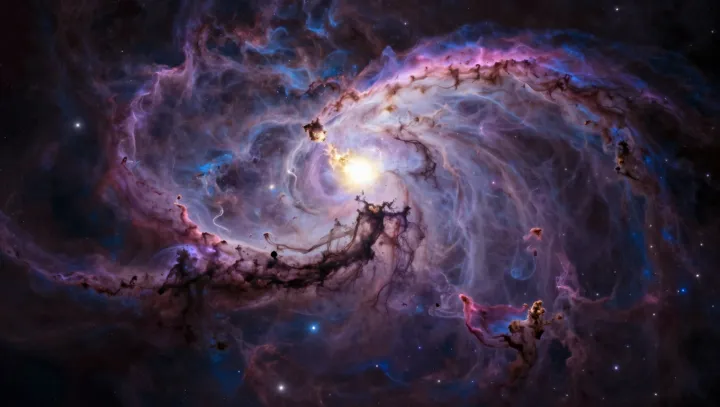
A dark nebula looks like a hole torn in the sky, yet it is anything but empty. Packed inside is cold gas dense enough to erase background starlight, turning the patch of space into a black cutout against the Milky Way.
The real twist is that this blackout is exactly what star birth needs. Dust grains in these molecular clouds absorb and scatter visible photons, creating extinction that hides what lies behind, while the same dust shields hydrogen and other molecules from harsh ultraviolet radiation that would otherwise heat and tear them apart. Shielded, the gas can cool to extremely low temperatures through radiative cooling lines of carbon monoxide and other species, lowering internal pressure until gravity wins. Then the cloud fragments. Dense cores form. Some begin to collapse into protostars.
Bright newborn giants are forged in these invisible cradles. As a collapsing core spins and accretes through a circumstellar disk, infall converts gravitational potential energy into heat, and nuclear fusion eventually ignites in the core once temperature and pressure cross the threshold. On the outside, though, the parent cloud still looks dark in optical light, even as embedded protostars blaze in infrared and submillimeter wavelengths that slip through the dust. To an optical telescope, the region is an absence; to an infrared observatory, it is a crowded nursery mid‑firestorm.