
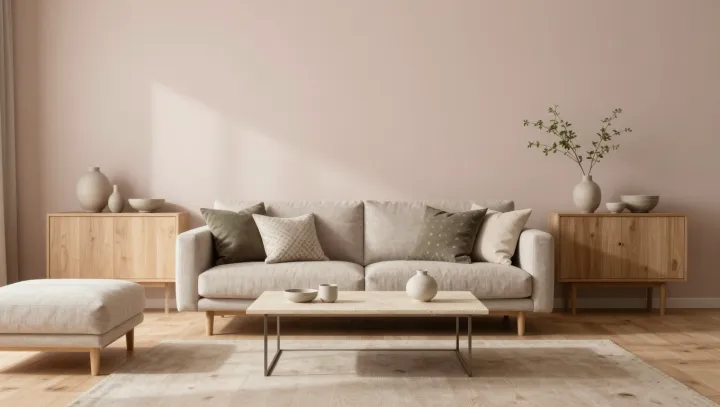
An almost-empty neutral room looks like sanity, yet psychologists increasingly argue it behaves more like a low-grade stress test for the brain. Research on attention restoration and sensory deprivation shows that uniform surfaces and repeated tones starve the visual system of the micro-variation it expects, forcing higher-order attention networks to work harder just to stay oriented.
By contrast, a strip of warm wood or a small patterned cushion acts as a controlled stimulus, not a decorative extra. Studies using electroencephalography and functional magnetic resonance imaging indicate that subtle natural textures trigger the ventral visual stream and limbic circuits in a way that stabilizes arousal, while still keeping prefrontal cortex demands low. The result is neither boredom nor overload, but a steady mid-range state in which cognitive resources recover.
Designers sometimes overcorrect toward extreme minimalism, assuming every added element is a threat to focus. Psychologists now suggest the opposite: a calibrated dose of organic grain and repeating motifs works like a mental buffer, similar to how low-level background noise protects against sudden acoustic shocks. What looks visually purist on a mood board can, in lived experience, become the very condition that quietly wears attention thin.