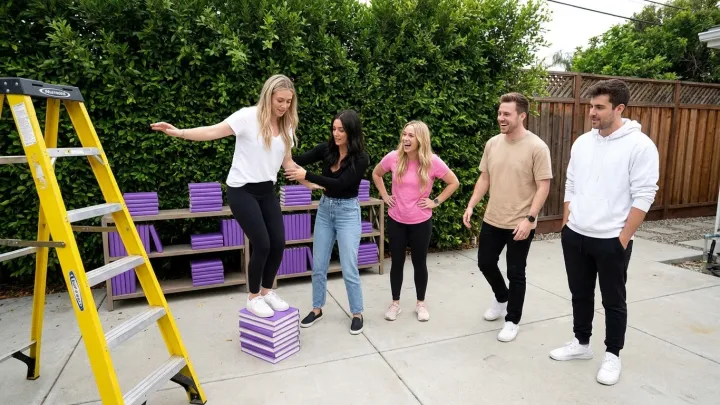
Height, not money or fame, was the first hierarchy targeted in Oakland when a same-height party quietly rewrote the social script. Inside a converted warehouse, the floor itself seemed to fracture into islands of dense foam platforms, each block measured and cut so every guest’s eyes aligned along a single horizontal axis, a human horizon line hovering just above the drink table.
The conceit is simple, yet the effect is not. Short guests stepped onto higher blocks; tall guests were gently downgraded to thinner pads, all calibrated with tape measures, spirit levels and the precision of ergonomic design. Eye contact stopped being a vertical negotiation and became, for once, a default setting. Small talk shifted. People who usually crane their necks relaxed their cervical spine; people used to towering lost that automatic, unconscious command of the room.
What sounds like a novelty party functions more like a live behavioral lab, minus the lab coats. Social psychologists would call it a controlled manipulation of status cues, stripping away one of the most visible phenotypic advantages without touching voice, clothing or charisma. Conversation clusters redistributed; jokes landed differently when delivered from exact visual parity. The organizers insist it is not therapy, not protest, just a one-night test of what happens when nobody has to look up, and nobody gets to look down.